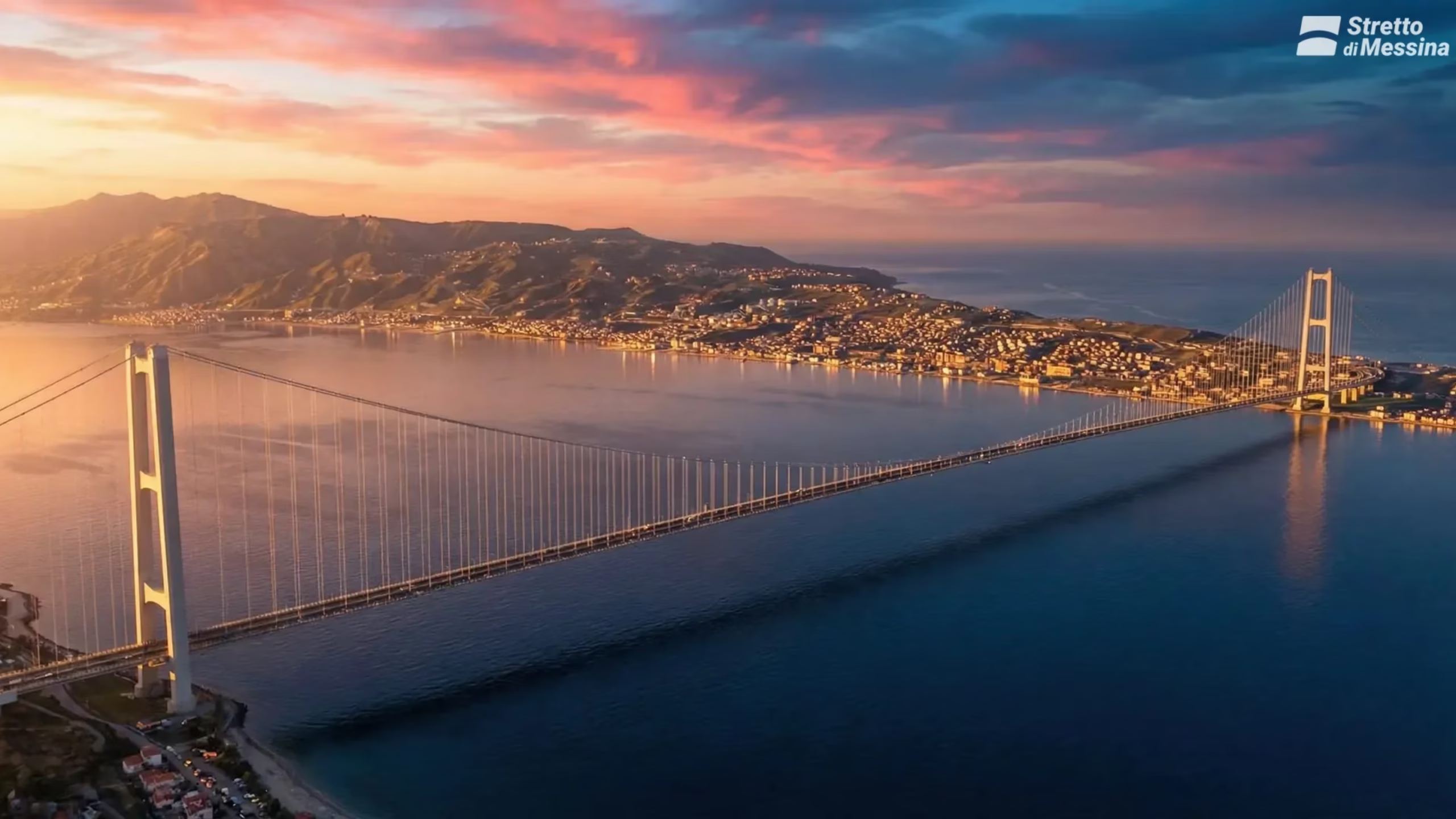
The €13.5 billion Strait of Messina Bridge is designed around a 3.3-kilometre suspended span — the longest ever proposed for a suspension bridge. But after the Court of Auditors refused to register the project’s key approval in 2025, Italy has spent 2026 rebuilding the administrative, environmental and technical case for construction.
The scheme is not only a bridge. As currently designed, it would carry a 3.666-kilometre deck, including a 3.3-kilometre central suspended span, hung between two towers rising to 399 metres. That would make it the longest suspension-bridge span ever built.
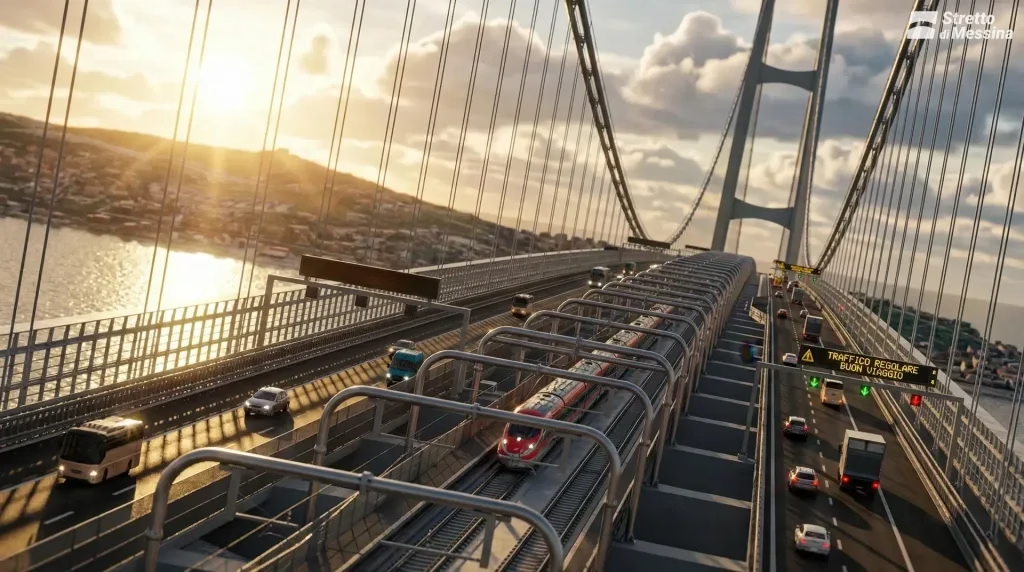
The deck carries six road lanes and two railway tracks, supported by four suspension cables each 1.26 metres in diameter. More than 40 kilometres of new road and rail connections are included, around 80 per cent of which run through tunnels, together with three new stations. Total project cost stands at approximately €13.5 billion.
Table of contents
THE SEQUENCE
The published programme envisaged Phase 2 – tunnels, junctions and three new railway stations – beginning in September 2026, followed by the main bridge works in March 2027, with completion targeted for 2032. Those dates are now subject to the renewed approval process.
The ordering itself is deliberate and, from a construction standpoint, sensible. The tunnels and approach works have their own long lead times and their own geotechnical risks. Starting them first means the bridge is not left waiting on its land connections when it is ready to open.
WHY A SINGLE SPAN
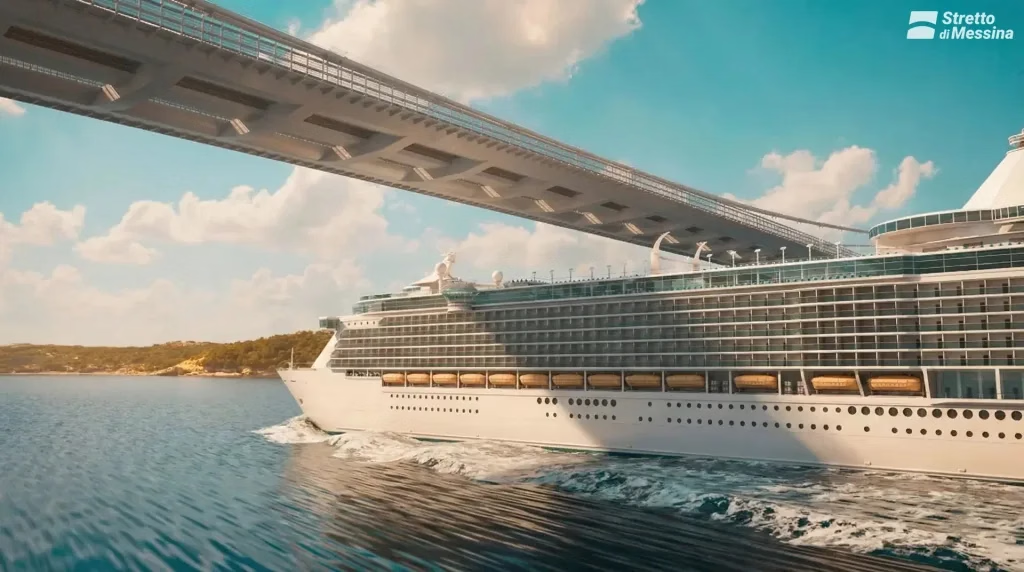
The Strait of Messina is deep, seismically active and heavily trafficked by shipping. Each of those conditions argues against putting towers in the water.
A single 3.3-kilometre suspended span avoids the strait entirely, placing both towers on land. That decision removes foundation work in deep water, removes the risk of a vessel striking a pier, and removes the problem of building piers in a seismic zone beneath the sea.
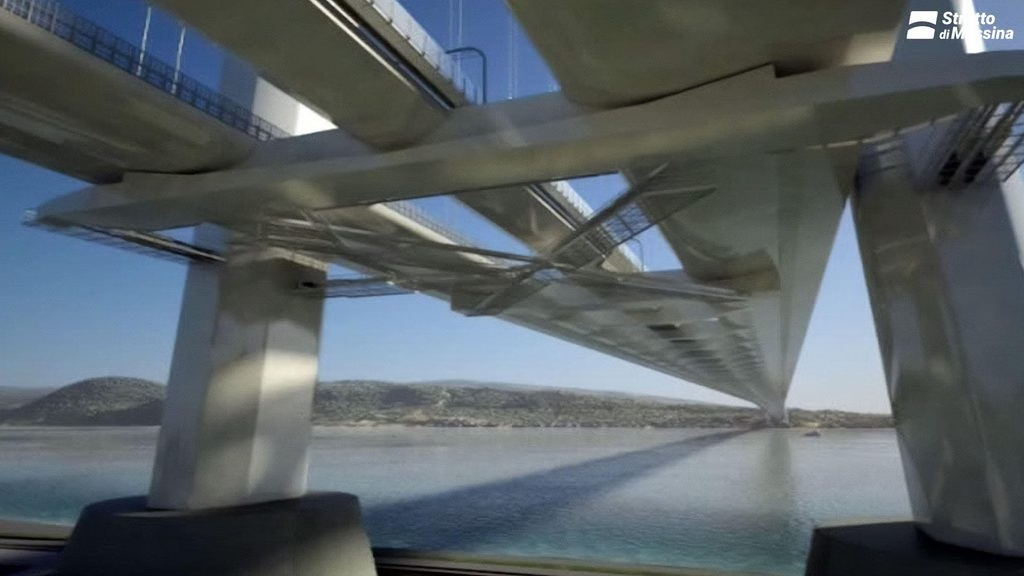
What it creates in exchange is a span longer than anything previously built, with all the consequences that follow – aerodynamic stability at that length, cable dimensions, tower height, and the behaviour of a very long, flexible structure under seismic and wind loading. Every long-span bridge is an exercise in choosing which problem to accept. Messina accepts an unprecedented span length in order to avoid the strait itself.
THE SEISMIC PROBLEM
The location makes the structural challenge sharper than span length alone. The Messina Strait sits on one of the most seismically active faults in Europe; the 1908 earthquake that destroyed the cities of Messina and Reggio Calabria remains among the deadliest in European history.
A suspension bridge of this length is, by nature, a flexible structure – and flexibility is not automatically a disadvantage in an earthquake, since a structure that can move can absorb energy a rigid one cannot. But designing a 3.3-kilometre span to behave predictably under both major seismic action and high wind, at the same time, is a problem with very little precedent to lean on. It relies on analysis and physical testing rather than on comparable structures, because comparable structures do not exist.
THE APPROVAL SETBACK — AND THE 2026 RESPONSE
The engineering case has always been the more straightforward half. The harder half is governance, and in late 2025 that half surfaced publicly.
The Court of Auditors refused to register the key CIPESS resolution, raising questions around financial coverage, traffic forecasts, environmental requirements, EU rules and aspects of the approval procedure. The decision was a legal-administrative setback, rather than a finding that the bridge’s engineering design was technically impossible.
Through 2026, the government and Stretto di Messina have worked to rebuild the case. The Superior Council of Public Works issued its opinion with prescriptions; the government approved the IROPI declaration establishing the works as being of overriding public interest under EU environmental rules; and a new CIPESS resolution is being prepared ahead of a further Court of Auditors review. The project therefore sits, at the time of writing, mid-way through a second approval attempt rather than at a dead end.
THE LONGER HISTORY
A fixed crossing of the Strait of Messina has been discussed, designed, approved, cancelled and revived repeatedly across decades. Previous iterations reached advanced design before being abandoned on cost or political grounds.
That history is relevant to how the current programme should be read. Dates announced for a scheme with this record deserve to be reported as targets rather than settled fact, and the 2032 completion date should be held with the same caution every previous Messina date eventually earned.
THE ENGINEERING QUESTION
When does extrapolation from existing practice stop being reliable?
A 3.3-kilometre suspended span would not simply extend the current record. It would require engineers to validate aerodynamic, seismic and structural behaviour at a scale without an existing built precedent – relying on analysis and testing rather than on comparable structures, because none exist. That is not an argument against building it. It is an argument for exactly the documentation, review and independent scrutiny the approval process is now, belatedly, working through.
THE ENGINEERING READ
The engineering ambition is clear, and has been for years. The outstanding question is whether the revised approval, environmental and procurement process can now move the project from an approved design on paper to a construction programme that can actually begin.
That is the reason to keep watching Messina. Not the span length, which the engineers can defend – but whether the process around it can finally carry an idea this ambitious from drawing to ground.
Key Takeaways
- The €13.5 billion Strait of Messina Bridge features a 3.3-kilometre suspended span, aiming to be the longest of its kind.
- Italy is currently revising the approval process after setbacks from the Court of Auditors in 2025.
- The project includes extensive new road and rail connections, with most running through tunnels.
- Challenges include seismic risks and ensuring the bridge behaves predictably under harsh conditions.
- As of 2026, the project is midway through another approval attempt, reflecting a long history of complex governance.