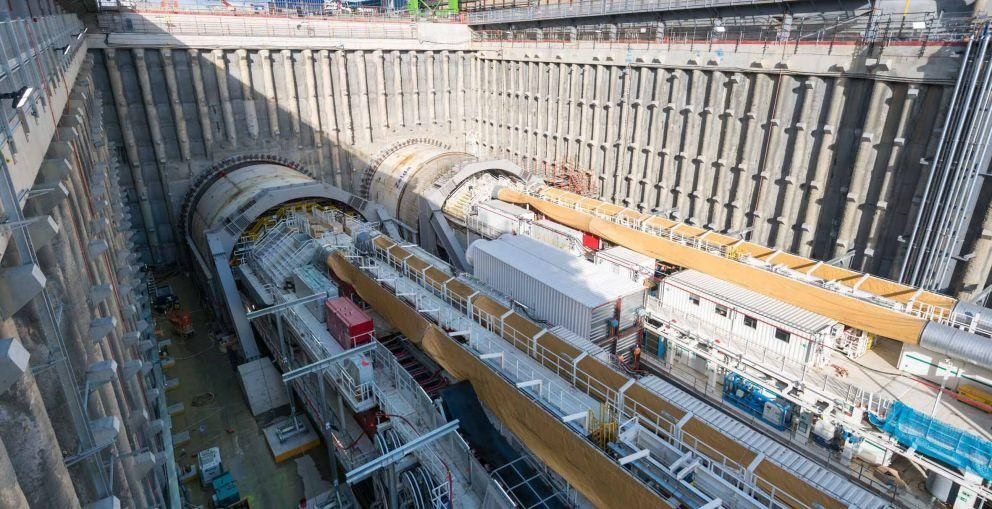
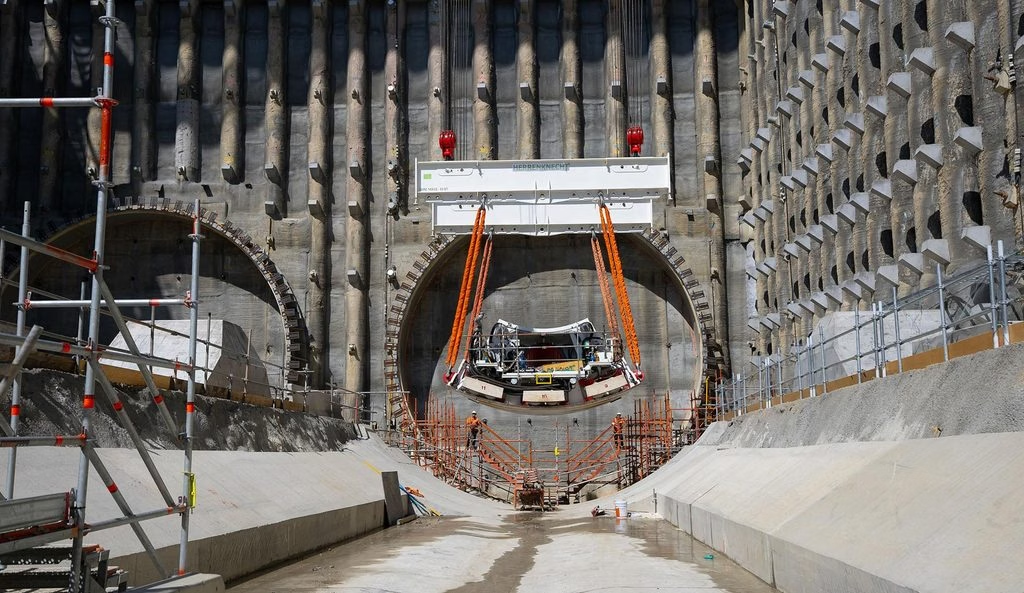
On 24 July 2026, TBM Gillian broke through at Bulleen, completing the southbound tunnel of the North East Link and bringing the project’s major tunnel boring phase to an end — on schedule, and with the harder, less visible half of the work still ahead.
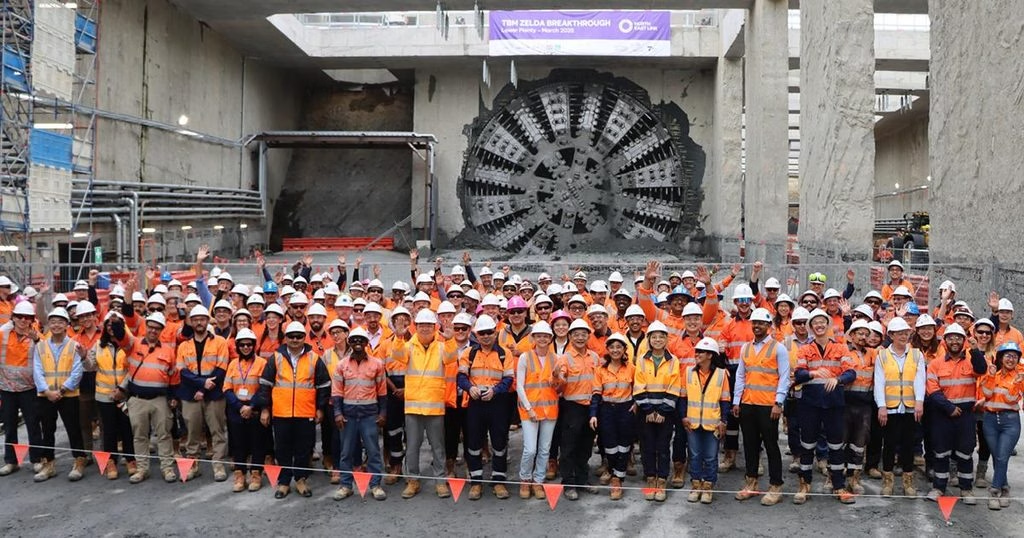
The breakthrough at Bulleen closed a drive of more than 5.3 kilometres from the launch pit at Watsonia. Gillian’s sister machine, Zelda, had completed the northbound tunnel in May. Between them, the two tunnel boring machines excavated the twin tunnels that will carry the North East Link beneath Melbourne’s northern suburbs.
The Victorian Government confirmed the excavation was completed on schedule. Across the two drives, the machines removed around 2.5 million tonnes of rock and soil and installed nearly 43,000 precast concrete tunnel segments — the lining rings that form the finished tunnel wall. On a project of this size, completing the bored tunnelling to programme is an achievement in itself; large road tunnels more commonly report slippage than steady delivery.
Table of contents
WHAT THE MACHINES WERE UP AGAINST ?
The alignment runs beneath established suburbs, existing infrastructure and the Yarra River. Tunnelling beneath a live urban area imposes constraints that have little to do with the rock itself.
Settlement is the first. Every metre of advance displaces ground, and above that ground sit houses, roads, services and, in places, heritage structures. Face pressure has to be managed continuously to keep surface movement within limits agreed long before the machine was launched.
The second is logistics. A TBM advancing through a city cannot stockpile spoil at the portal indefinitely, nor can it accept deliveries at any hour. Segment supply, spoil removal and grout delivery all have to work within the constraints a residential area imposes.
The third is depth. At its deepest point, the alignment takes the TBMs roughly 45 metres below ground as they pass beneath the Yarra River — working under a variable water head with no possibility of surface intervention if something goes wrong. That is the section where advance rates typically slow and monitoring intensifies.
WHY TUNNELS RATHER THAN SURFACE ?
The North East Link closes a long-standing gap in Melbourne’s orbital road network between the M80 Ring Road and the Eastern Freeway. That gap has existed for decades, and the reason it persisted is the same reason the scheme became a tunnel project.
A surface alignment would have required acquiring a corridor through established residential areas and parkland. The property acquisition, community disruption and environmental cost of doing so were judged unacceptable. Driving the connection underground transfers that cost from the surface to the construction programme.
That is the fundamental trade in urban road projects. Tunnelling is more expensive per kilometre than surface construction, sometimes substantially so. What it buys is the avoidance of surface impacts that cannot be priced simply — severed neighbourhoods, lost parkland and years of disruption along an open corridor.
WHAT REMAINS ?
Excavation is the visible milestone, but it is not the finish line.
The tunnels will not carry traffic until 2028. Between now and then, crews must install approximately 700,000 tonnes of road surface and 3,300 kilometres of cabling, together with 51 emergency passages and the ventilation, fire protection, lighting, drainage, signage and control systems required to make a modern road tunnel operable.
Fit-out on a project of this type routinely accounts for a substantial share of both cost and programme. It also tends to be where schedules are recovered or lost, because it involves many trades working in a confined linear environment where sequence matters enormously.
THE ENGINEERING READ
For practitioners, the transferable point is not the length of the drive.
It is that a tunnel completed to programme is almost always the result of decisions taken before the machine was launched — ground investigation thorough enough to remove surprises, machine specification matched to the ground actually present, and a logistics chain designed for the constraints of the site rather than adapted to them later.
The second point concerns expectation management. A breakthrough generates photographs and headlines, and it is easy for a public audience to read it as completion. It is not. Two more years of fit-out separate the North East Link’s last excavated metre from its first vehicle, and communicating that distinction is part of delivering a project of this profile.
WHAT THE BREAKTHROUGH DOES NOT TELL YOU?
One further caution applies to reading tunnelling milestones generally.
A completed drive says nothing on its own about the condition of the tunnel behind the machine. Segment ring quality, annulus grouting, waterproofing performance and the accuracy of the as-built alignment all determine whether the fit-out that follows proceeds smoothly or encounters remedial work.
Those measures are recorded continuously during the drive, and they are the figures a project team examines after the ceremony ends. On a well-run drive they confirm what the programme already suggested. On a poor one they explain why the following phase runs long.
Melbourne’s drives are complete, and completed on schedule. Whether the tunnels behind them are as good as that milestone suggests will emerge over the next two years, in the ordinary and unglamorous business of fitting out — which is where the North East Link, like every major tunnel, will actually be judged.
Sources :
Victoria’s Big Build / North East Link Program; Victorian Government announcement, 24 July 2026; Webuild; Australian Government Department of Infrastructure, Transport, Regional Development and Local Government
Key Takeaways
- The TBM Gillian completed the southbound tunnel for the North East Link on schedule, following a 5.3-kilometre drive from Watsonia.
- Tunnelling faced challenges like settlement, logistics, and depth, especially beneath urban areas and the Yarra River.
- Constructing the North East Link as a tunnel avoided the disruption and costs of a surface route through established residential areas.
- The tunnels will not be operational until 2028, requiring extensive fit-out work including road surface and cabling installations.
- A breakthrough does not guarantee quality; the condition of the tunnel behind needs continuous monitoring during the fit-out phase.