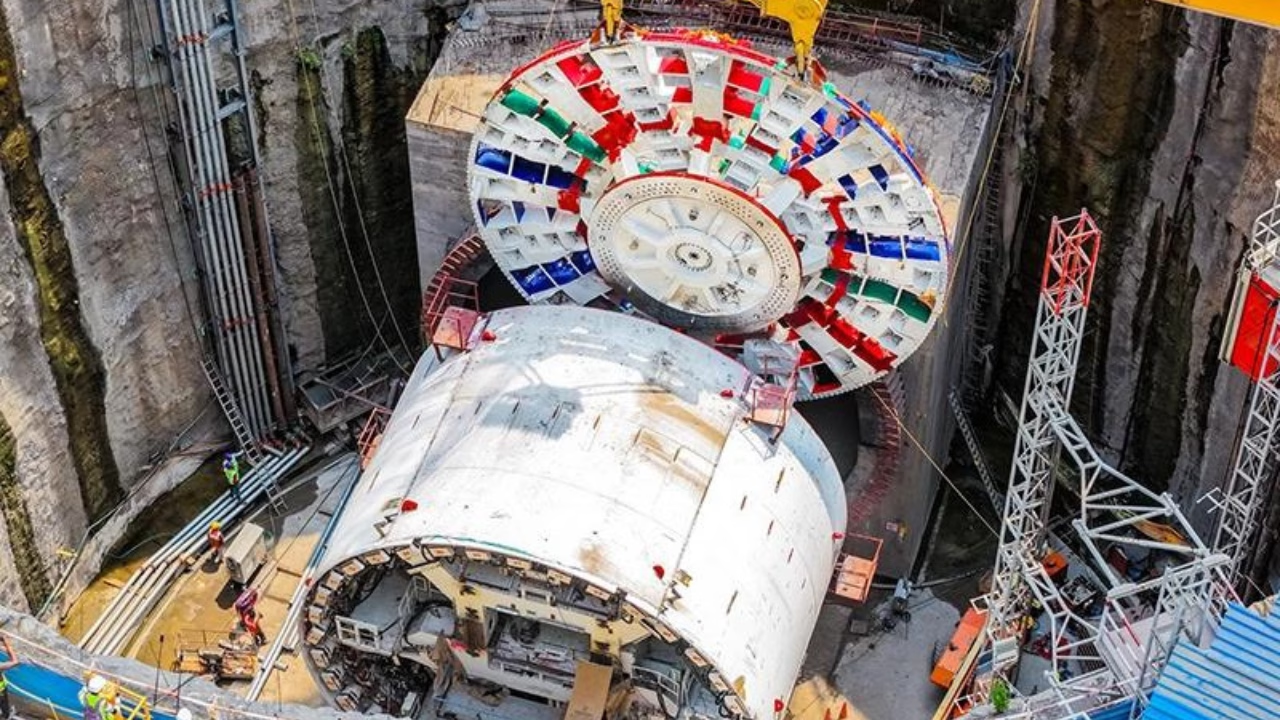
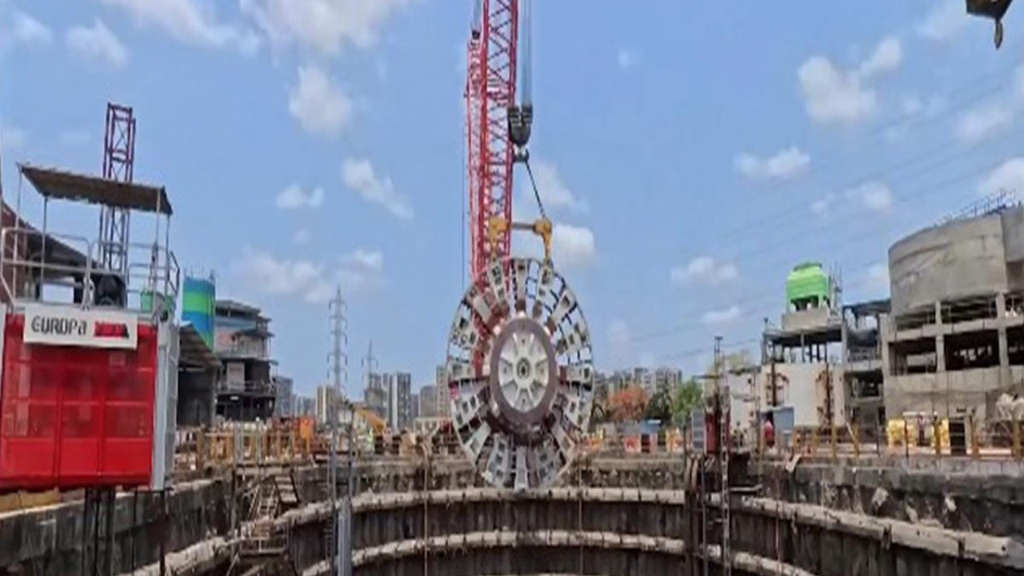
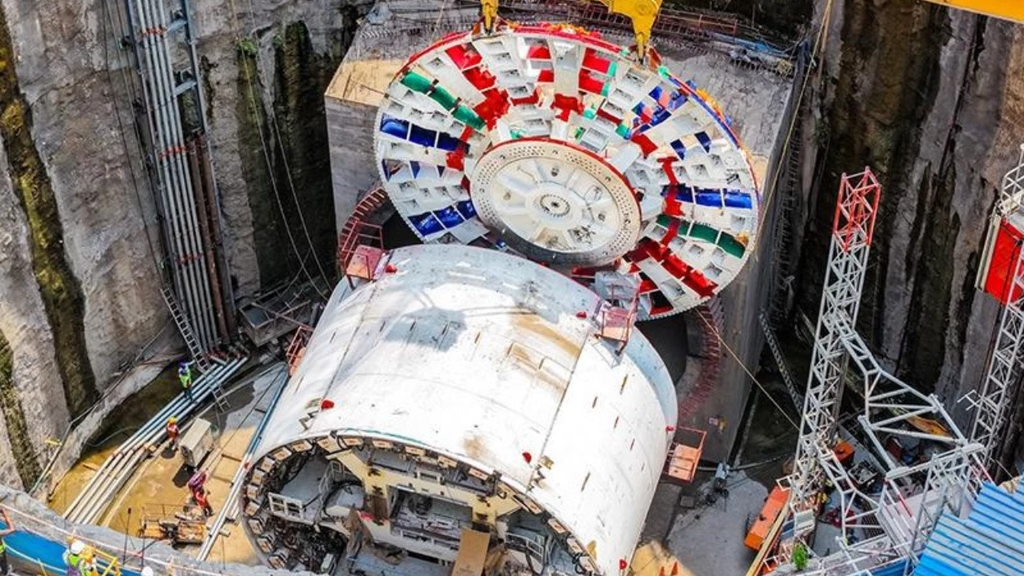
Union Railways Minister Ashwini Vaishnaw has targeted 15 August 2027 for the first service on India’s Mumbai–Ahmedabad High Speed Rail corridor, with operations planned to begin in phases. The tunnelling programme is now moving rapidly: three mountain tunnels in Maharashtra have achieved breakthrough, while two tunnel boring machines are excavating the 21-kilometre underground section approaching Mumbai, including India’s first undersea rail tunnel beneath Thane Creek.
The corridor runs 508 kilometres – 352 kilometres in Gujarat and Dadra & Nagar Haveli, 156 kilometres in Maharashtra – serving 12 stations at a design speed of 320 km/h. Journey time between Mumbai and Ahmedabad falls to roughly two hours.
Delivery is by the National High Speed Rail Corporation Limited (NHSRCL), using Japanese Shinkansen technology and financed through a 50-year loan from Japan of approximately ₹88,087 crore at 0.1 per cent interest, with repayment beginning 15 years after the line opens.
Operations begin between Surat and Bilimora, followed by Vapi–Surat, then Vapi–Ahmedabad, and finally Thane–Ahmedabad.
Table of contents
WHY PHASED OPENING
Opening a high-speed line in sections rather than all at once is a deliberate risk management strategy.
The Gujarat sections are the most straightforward. The terrain is comparatively flat, land acquisition proceeded faster, and construction has been further advanced for some time. The Maharashtra sections – particularly the approach to Mumbai – are the difficult ones, involving the undersea tunnel, dense urban approaches and more complex land assembly.
Opening the easier sections first allows the operating railway to begin building experience, revenue and public confidence while the harder engineering continues. It also means a delay in Maharashtra does not delay the entire corridor.
The trade-off is that a partially opened high-speed line delivers only a fraction of its journey time benefit. A Surat–Bilimora service is not what the project was built for.
THE TUNNELLING
The alignment includes seven mountain tunnels and one undersea tunnel.
The recently reported breakthrough of approximately 1.5 kilometres connecting Virar and Boisar in Palghar district was the second mountain tunnel breakthrough in Maharashtra. Progress on these is the clearest indicator of whether the Maharashtra sections will meet their programme.
The undersea section, beneath Thane Creek, is India’s first undersea rail tunnel. It is the single most technically demanding element of the corridor, and the one with the least domestic precedent. Tunnelling beneath a marine environment introduces water pressure management, ground conditioning and settlement risks that mountain tunnelling does not.
Track construction uses the J-Slab ballastless system derived from Shinkansen practice. Slab track is standard on high-speed lines because ballast becomes unstable at very high speeds and because maintenance access on a busy high-speed railway is extremely constrained.
THE SCHEDULE HISTORY
The 2027 date is not the first target announced for this project.
Earlier targets included 2022 and 2023. Land acquisition in Maharashtra, in particular, took considerably longer than originally planned, and construction in that state started well behind Gujarat as a result.
This history is worth stating plainly rather than omitting. It is also instructive: on Indian infrastructure projects as elsewhere, land acquisition rather than engineering is frequently the governing constraint, and programmes that assume otherwise tend to slip.
THE ENGINEERING READ
For practitioners, the transferable point concerns technology transfer.
The corridor is not merely buying Japanese rolling stock. It is adopting Shinkansen civil engineering standards — alignment geometry, slab track, signalling and operating practice — as an integrated system. That approach shortens the learning curve substantially, because the standards arrive proven.
What it also does is commit the project to those standards throughout. Slab track, Shinkansen-specification tunnels and the associated tolerances are not elements that can be locally substituted without unpicking the system.
For a country building its first high-speed railway, that is a defensible trade: accept a tightly specified imported system in exchange for removing the risk of developing standards from scratch. The knowledge that transfers is in the execution, and India is now executing seven mountain tunnels and an undersea crossing to those standards.
WHAT THE CORRIDOR IS ACTUALLY FOR
The engineering case for the corridor rests on more than journey time.
Mumbai and Ahmedabad sit at either end of one of India’s most economically active corridors, and the existing rail connection is shared with freight and conventional passenger services. Adding high-speed capacity on a dedicated alignment does two things at once: it provides fast intercity travel, and it releases capacity on the existing network for the freight and regional services that currently compete with it.
That second effect is routinely underweighted in public discussion of high-speed rail, and it is frequently the stronger part of the economic case.
There is also an industrial dimension. Building 508 kilometres of high-speed railway develops domestic capability in slab track installation, precision alignment, high-speed tunnelling and the systems integration that high-speed operation demands. Whether that capability is retained and applied to subsequent corridors will determine how much long-term value the investment produces.
India has announced further high-speed corridors. The workforce and supply chain being built on this one is what those depend on.
Key Takeaways
- Union Railways Minister Ashwini Vaishnaw aims for the Mumbai–Ahmedabad High Speed Rail corridor to start operations by 15 August 2027, with tunnelling rapidly progressing.
- The corridor covers 508 kilometres and will significantly reduce travel time between Mumbai and Ahmedabad to about two hours.
- It follows a phased opening strategy to manage risks, starting with easier sections in Gujarat before tackling more complex sections in Maharashtra.
- The project adopts Japanese Shinkansen technology, ensuring high engineering standards and the development of local capabilities in high-speed rail construction.
- The corridor not only provides fast travel but also frees up capacity in the existing rail network for freight and regional services.