Why Factory-Based Construction Is Becoming a Serious Delivery Model
Modular and offsite construction have moved well beyond temporary buildings and repetitive housing blocks. They are now being used to address some of construction’s most persistent problems: weak productivity, labour shortages, inconsistent quality, schedule risk and site congestion.
Market data reflects that shift. Astute Analytica valued the global modular construction market at about USD 90.3 billion in 2024 and projected it to reach USD 155.2 billion by 2033. Forecasts vary by source, but the direction is clear: more clients and contractors are treating factory-based construction as a practical delivery model rather than an experimental method.
What Modular and Offsite Construction Mean
The principle is straightforward. Instead of building every element from raw materials on site, selected parts of a building or infrastructure asset are manufactured in a controlled facility, transported to site and installed.
This can include volumetric modules, bathroom pods, façade panels, precast concrete elements, MEP racks, plant skids, structural wall panels and hybrid assemblies. McKinsey describes the modular construction market as covering everything from large structural frames and panels to fully serviced rooms and complete building units.
The level of modularisation depends on the project. A hospital may use prefabricated corridor racks and bathroom pods. A hotel may use volumetric room modules. An industrial plant may use skid-mounted process or utility packages. Infrastructure projects may use precast elements, modular substations or factory-built service buildings.
Why Contractors Are Moving Work Offsite
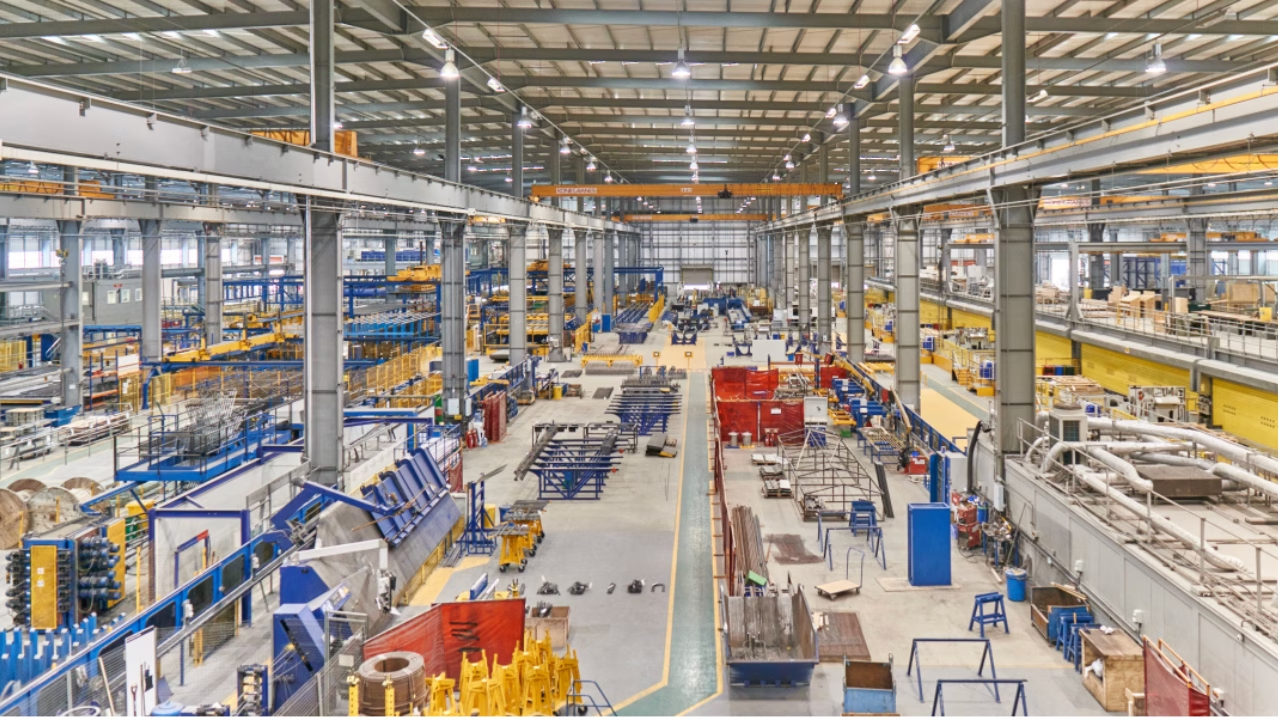
Factories offer conditions that construction sites rarely provide. Work can be repeated, inspected at defined stages and protected from weather. Materials can be stored more efficiently, tools remain close to the workface, and quality checks can be built into the production sequence.
McKinsey notes that modular construction can improve productivity, reduce manpower requirements and accelerate project timelines when applied correctly and at scale. Its research points to schedule acceleration of up to 50 percent in suitable conditions.
This is especially valuable where earlier completion creates direct financial or public-service benefits. Hotels, student accommodation, hospitals, data centres, schools and repeatable infrastructure buildings are strong candidates because many elements can be standardised without reducing functionality.
Better Programme Control
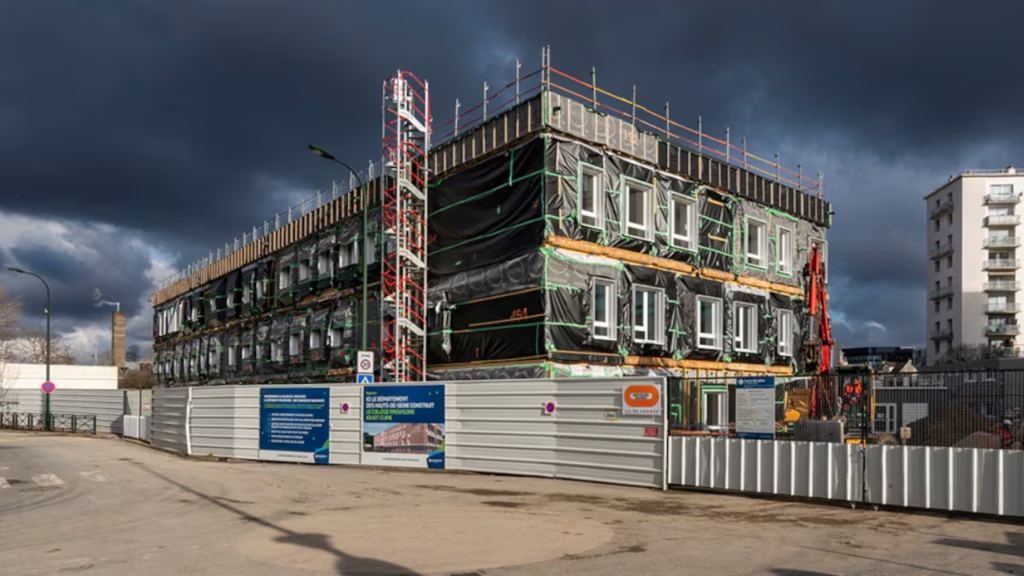
Schedule certainty is one of the strongest arguments for offsite construction. Traditional site work is exposed to weather, trade stacking, access restrictions, subcontractor delays and rework. Offsite production allows manufacturing to proceed while foundations, utilities or enabling works continue on site.
That overlap can shorten the overall project duration. It also reduces the number of activities competing for space on congested sites. In dense urban projects, hospitals, live campuses and industrial facilities, fewer on-site operations can improve safety, logistics and public disruption management.
Quality Benefits in Controlled Production
Quality is another major reason clients are taking modular delivery seriously. Factory production supports jig-based assembly, repeatable workmanship, digital component tracking and inspection before delivery.
This is particularly useful for mechanical, electrical and plumbing systems. Poorly coordinated MEP work often causes clashes, access problems, leaks and commissioning delays. Prefabricated MEP racks allow multiple services to be assembled in safer working conditions and installed quickly once the site is ready.
Dodge Data & Analytics reported that about 90 percent of surveyed users of prefabrication and modular construction achieved improved productivity, improved quality and increased schedule certainty compared with traditional construction.
The Method Requires Early Design Discipline
Modular construction works best when the project is designed for it from the beginning. Late changes are expensive once factory production starts. Transport dimensions, lifting strategy, connection details, fire performance, acoustic requirements, tolerances, waterproofing and installation sequence must be resolved before manufacturing.
A weak design freeze can quickly remove the benefits. Architects, structural engineers, MEP designers, manufacturers, logistics teams and installers need to work from a coordinated model. The delivery team must decide early which parts should be manufactured offsite and which parts are better built conventionally.
Supply Chain and Capacity Risks
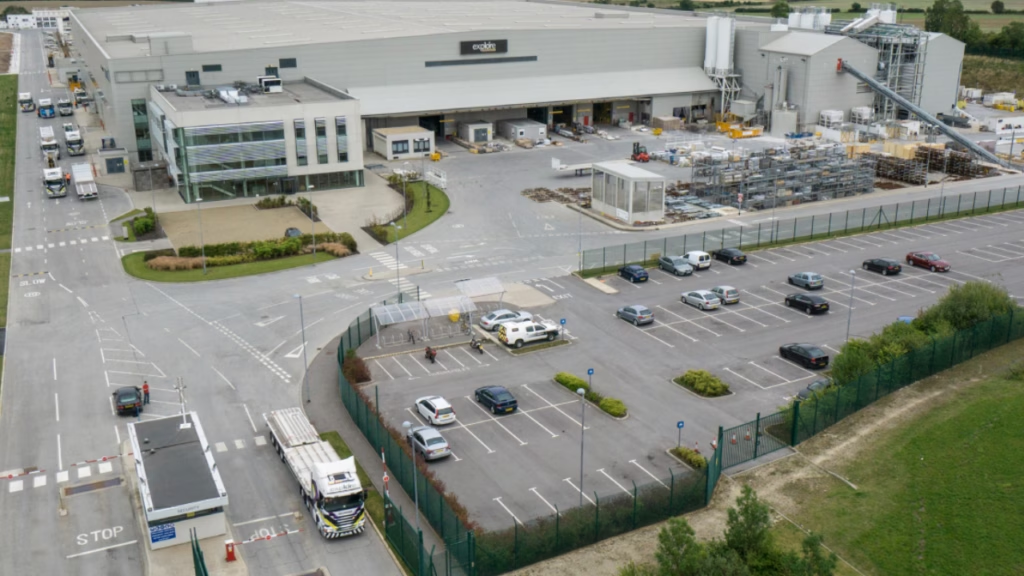
Factory-based construction also changes the risk profile. Labour moves from site to manufacturing facilities. Suppliers need production capacity, quality systems, digital workflows and stable procurement pipelines.
Clients should assess modular suppliers with the same seriousness applied to main contractors. Financial strength, factory capacity, design capability, logistics experience and installation support all matter. If one factory becomes the critical supply point and falls behind, the project can lose the programme certainty it was trying to gain.
Sustainability and Waste Reduction
Sustainability is becoming a stronger part of the case. The Modular Building Institute states that building in a controlled environment can reduce waste through upstream avoidance, improve quality management and reduce site disturbance.
The benefit is strongest where projects use repeatable components, standardised details and designs that allow future replacement or disassembly. Waste reduction is achievable, but it still needs evidence through material tracking, lifecycle assessment and transport impact analysis.
The Future Is Hybrid
The most practical future for modular construction is hybrid delivery. Foundations, basements, civil works and bespoke architecture may remain site-led. Repetitive rooms, services, façades, plant areas and structural components can shift to controlled production.
The best contractors will allocate each work package to the environment where it can be done most safely, predictably and efficiently. That is why modular and offsite construction are gaining ground: they bring manufacturing discipline into an industry that urgently needs better control over time, cost and quality.
Article credits
- Modular Building Institute (MBI)
- McKinsey & Company – Modular Construction: From Projects to Products
- Dodge Construction Network (formerly Dodge Data & Analytics)
- Astute Analytica – Modular Construction Market