
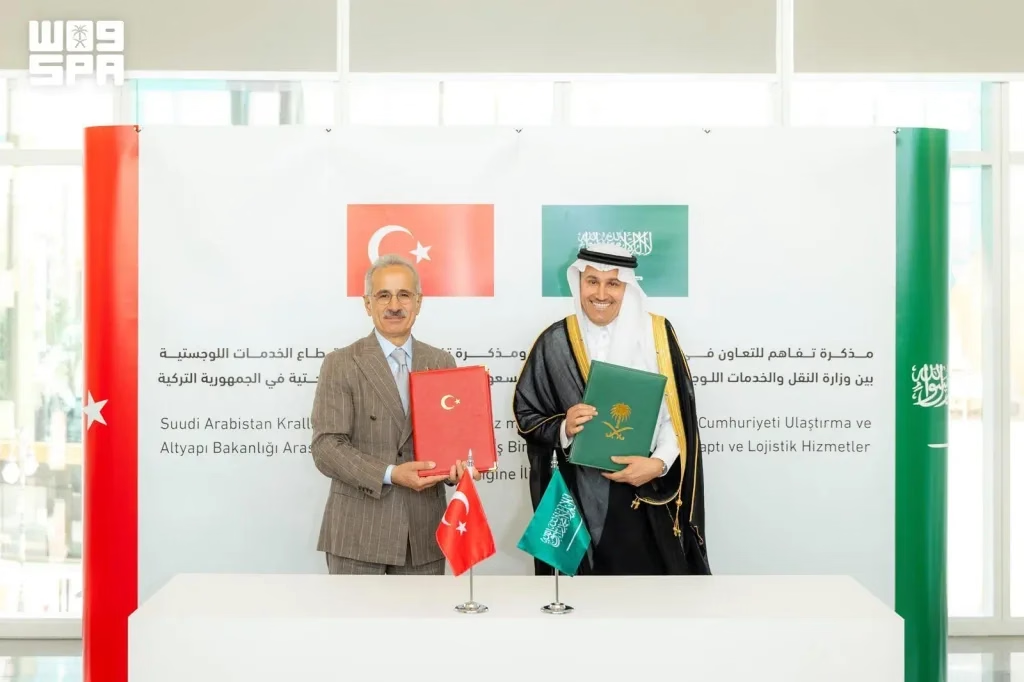
Saudi Arabia and Turkey signed two memorandums of understanding in Riyadh on 9 June covering railway and logistics cooperation, as both countries explore a future rail corridor linking Saudi Arabia with Turkey through Jordan and Syria — and potentially onward to Europe. A final alignment, financing plan and construction programme have not yet been agreed.
The agreements were signed by Saudi Minister of Transport and Logistic Services Saleh Al-Jasser and Turkish Minister of Transport and Infrastructure Abdulkadir Uraloglu. There were two: one covering railway cooperation — infrastructure, technology, standards, safety, engineering, training and operations — and one covering logistics services, including logistics centres.
These are not merely diplomatic statements. A joint feasibility study for the Saudi–Jordan–Syria–Turkey connection is already underway, which Saudi Transport Minister Saleh Al-Jasser has said should be completed by the end of 2026. A corridor of this kind would still be one of the largest transport undertakings anywhere in the world, and it is worth examining what actually stands between the agreements and a working railway.
WHAT ALREADY EXISTS — AND WHAT DOES NOT
The starting position is stronger than it first appears. Saudi Arabia already has rail infrastructure extending from Riyadh toward Al Haditha near the Jordanian border; its North Train passenger route runs approximately 1,250 kilometres in that direction, and the transport minister has confirmed the national network already reaches the Jordanian border.
The principal missing international connection lies beyond that point: through Jordan and Syria to Turkey. Iraq has been mentioned as a possible additional participant, rather than as a necessary part of the currently studied route. Reuters has reported that a roughly 400-kilometre missing section between Syria and Jordan is among the core infrastructure gaps, and Syria’s network carries the added complication of war damage requiring restoration or reconstruction.
TRACK GAUGE
Track gauge is one of the corridor’s key technical questions, though not the blanket obstacle it might appear. Saudi Arabia and Turkey use 1,435 mm standard gauge, as does most of Syria’s modern rail network, while Jordan’s historic Hejaz infrastructure is largely 1,050 mm narrow gauge.
A modern through-freight corridor would therefore require substantial reconstruction or new standard-gauge infrastructure through the Jordanian section, rather than relying unchanged on the historic railway. This is a genuine but well-understood piece of civil engineering: gauge conversion and new-build to a single standard is established railway practice, not a novel problem.
THE STRATEGIC LOGIC
The commercial argument rests principally on freight and supply-chain resilience. Turkey’s transport minister has described the proposed corridor as carrying goods, energy products and passengers between Saudi Arabia, Jordan, Syria, Turkey and Europe, and the June discussions were framed partly around creating alternatives to disrupted maritime routes.
Sea freight from the Gulf to Europe currently routes through the Suez Canal, a chokepoint whose vulnerability has been demonstrated repeatedly in recent years. A land corridor could offer a faster alternative for selected higher-value and time-sensitive cargo, while diversifying routes away from maritime chokepoints — rather than replacing sea freight broadly, which it would not.
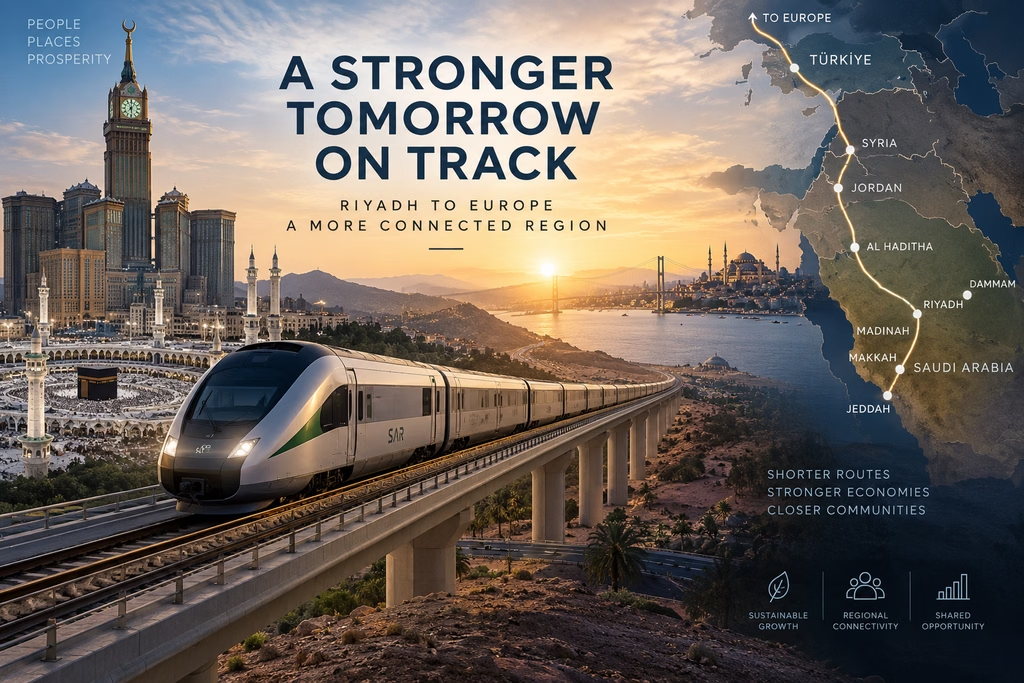
There is also a passenger dimension. Turkish officials have said the future connection could facilitate pilgrim travel, and the historic Hejaz Railway itself was built partly to carry pilgrims toward Medina. Passenger services could eventually add that pilgrimage dimension, particularly if the international corridor is integrated with Saudi Arabia’s wider passenger network and the Haramain High Speed Railway serving Makkah and Madinah. The June agreements do not, however, establish a route through either city.
WHAT THE MOUS DO AND DO NOT DO
A memorandum of understanding commits the parties to cooperate. It does not commit funding, fix a route, allocate risk or establish a delivery entity. The feasibility study now underway is the meaningful next step; a defined alignment, binding agreements and identified financing lie beyond it.
Turkey has since suggested that the physical Saudi–Turkey connection could be established within three to four years. That remains an ambition rather than a funded construction programme: detailed financing, alignment and cross-border implementation arrangements are still being developed.
THE ENGINEERING READ
For practitioners, the interesting question is not whether the corridor gets built. It is what determines whether corridors like this ever do.
The engineering challenges are substantial — a 400-kilometre missing section, war-damaged Syrian infrastructure, gauge conversion or new-build through Jordan, signalling integration, terminals and border facilities — but they are largely within established railway practice. The more difficult constraint may be institutional: maintaining agreement across several countries on standards, financing, border operations, signalling, safety and long-term infrastructure management.
The strongest way to read this project, then, is not “Saudi Arabia is building a railway to Europe.” The physical railway is technically achievable. The real megaproject is creating a continuous international railway system across Saudi Arabia, Jordan, Syria and Turkey — with compatible infrastructure, standards, customs, financing and operating rules held together across borders and over the decades such a corridor takes to build.
WHAT WOULD SIGNAL PROGRESS
For anyone tracking the corridor, five indicators would distinguish genuine advance from diplomatic activity. First, completion of the feasibility study, expected before the end of 2026. Second, publication of a defined alignment — especially where the route crosses Jordan and Syria, and whether existing corridors are rebuilt or bypassed. Third, a standard-gauge solution through Jordan and rehabilitation of Syria’s network. Fourth, binding multilateral agreements covering customs, operations, signalling, maintenance and border procedures. Fifth, a financing structure, particularly for the reconstruction and new-build sections in Syria and Jordan.
None of these is yet in place. That is entirely normal at this stage — and it is also the reason to describe the current position as what it is: a serious, jointly studied ambition, at the very start of a long road.
Sources: Saudi Ministry of Transport and Logistic Services; Turkish Ministry of Transport and Infrastructure; Saudi Arabia Railways (SAR); Reuters; Saudi Press Agency. Status as reported to September 2026 — a jointly studied proposal, not an approved construction programme. | www.cewmagazine.com